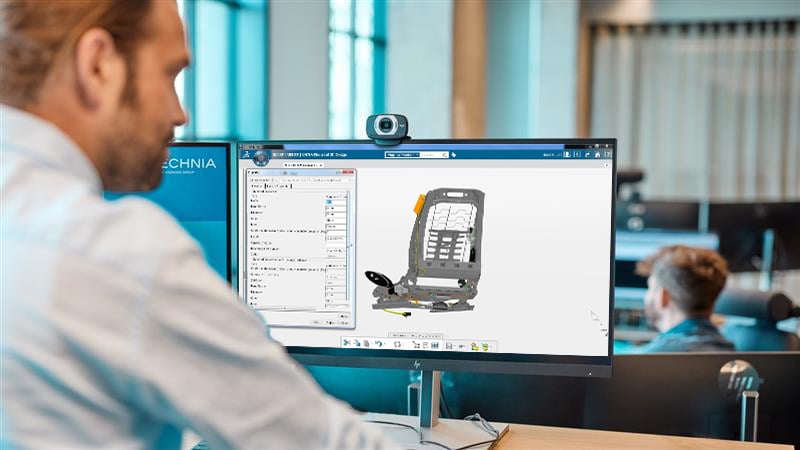
Command Intelligence predicts relevant CATIA commands based on context and user intent. It reduces time spent searching menus, supports consistent methods, and helps engineers work more efficiently from the start.
Design Faster. Reduce Rework. Control Complexity.
Capabilities That Drive Results
Discover how 3DEXPERIENCE CATIA supports engineering work with AI-powered capabilities that improve accuracy, speed up workflows, and help teams create better models with less manual effort.
Interested? Read more in-depth information about the AI functions that enhance 3D modelling workflows.
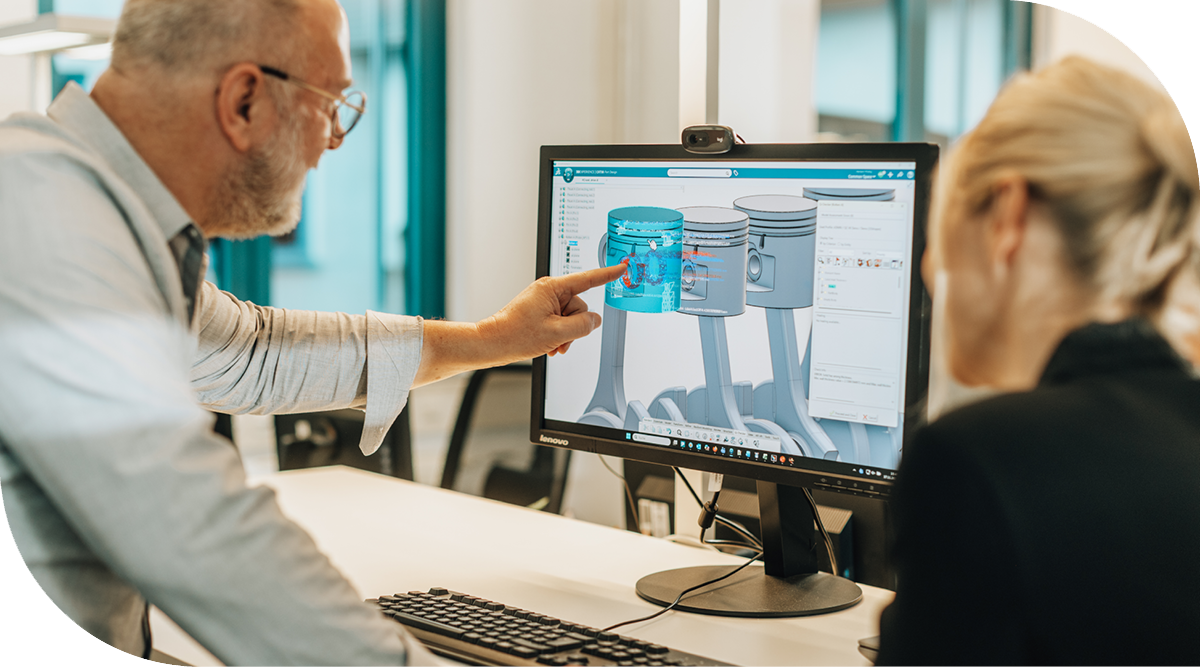
Command intelligence
Generative constraints*
Generative Constraints automatically analyze sketch geometry and apply appropriate constraints. This reduces manual input, improves sketch robustness, and captures design intent early while supporting engineering standards.
Mechanical prediction*
Mechanical Prediction analyzes part geometry to identify functional interfaces and predict mechanical relationships. It helps define connections faster, reduces setup time, and minimizes errors during assembly design.
What's New in CATIA R2026x
Discover the latest advancements in CATIA R2026x, where AI-driven design, advanced simulation, and Virtual Twin technology come together to unleash a new Space of Possibilities for your engineering workflows.

How Will Generative AI Shape the Future of Digital Engineering?
Explore key insights from real-world engineering practice and expert discussions.
An AI Ready Stack for Digital Engineering
Manufacturers across the Nordics and the Netherlands face the same challenge. They must deliver more innovation with fewer errors, tighter budgets, and strict compliance requirements. Adopting AI in engineering requires more than isolated experiments. It requires a foundation that can scale.
This approach is built on an AI ready stack that connects data, engineering systems, and workflows, allowing organizations to move AI from pilot projects into production.
TECHNIA helps turn this foundation into everyday operations. Through guidance, implementation, system integration, data migration, and certified training, we support organizations in building a scalable digital engineering environment. These initiatives are delivered through KPI led rollouts that connect strategic goals with daily engineering work. The result is practical use of generative AI, increased reuse, and measurable improvements in speed, cost, and quality.
JOHANNES STORVIK
CHIEF SOLUTIONS OFFICER, TECHNIA
"Organizations don’t buy “AI”; they buy outcomes – fewer errors, faster launches, stronger governance at lower total cost."
- Fragmented product data is the primary barrier to scaling AI.
- Disconnected workflows limit ROI and slow adoption.
- Major opportunity: unify data, workflows, and governance into an AI-ready stack


AI-Driven Design Intelligence in 3DEXPERIENCE CATIA
Learn how AI is embedded directly into CATIA to support modeling, sketching, and assembly work. This article explains how intelligent assistance reduces manual effort, supports design intent, and helps engineers focus on higher-value decisions across the product lifecycle.

Concurrent Working in 3DEXPERIENCE CATIA
Discover how multiple users can work on the same product definition while maintaining data integrity. This article explains controlled locking, real-time visibility, and collaborative tools that enable concurrent engineering without conflicts.

Multi-CAD Structure in 3DEXPERIENCE
Explore how the 3DEXPERIENCE platform supports unified product structures across multiple CAD systems. Learn how centralized data management, revision control, and cross-tool collaboration support complex, multi-disciplinary product development.
Intelligent design for Aerospace & Defense
AI-supported engineering in aerospace and defense
Aerospace and Defense companies operate in highly complex engineering environments where safety, performance, and compliance are essential. At the same time, development timelines are getting shorter, and demands for sustainable aircraft, advanced defense systems, and resilient supply chains continue to grow. Traditional engineering approaches are no longer enough. AI capabilities in aerospace and defense design help teams explore options earlier, manage complexity, and move faster across design, engineering, and lifecycle stages, while improving quality and reducing risk, time, and cost.
As structures and systems become more complex, traditional design approaches reach their limits. AI-powered capabilities in CATIA support new ways of working across design, engineering, and validation.
CATIA uses generative design to create and evaluate a wide range of concept alternatives. Engineers can assess structural performance, weight, and manufacturability early, supporting innovation without compromising safety.
AI-driven features such as contextual command suggestions and geometry analysis reduce repetitive modeling work. This frees up time for engineering judgment and problem-solving in mission-critical systems.
AI-powered design workflows for Transport & Mobility
Shaping the Future of Automotive Innovation
How is the automotive industry changing through cloud technology, AI, and digital collaboration? See in action the shift toward software-defined vehicles, where innovation increasingly happens at the intersection of hardware and software. They explore how virtual twin experiences on the 3DEXPERIENCE platform support greater agility, efficiency, and smarter mobility solutions.
To stay competitive, engineering teams need faster, more adaptive, and more collaborative design workflows. AI-powered capabilities in CATIA support this shift across design and development.
Context-aware command intelligence supports engineers by predicting next actions and reducing repetitive modeling steps. This accelerates model creation and helps teams focus on system-level design decisions.
Generative design supports lightweighting, structural efficiency, and multi-material use. Engineers can evaluate configurations early to balance performance, efficiency, and compliance requirements.
Precision-driven AI workflows for Life Sciences
How Life Sciences Companies Are Adopting AI
Life Sciences organizations face growing demands for precision, quality, and regulatory compliance while developing patient-centric products. Increasing system complexity and strict manufacturing requirements require new approaches to design, validation, and production.
AI-powered capabilities in CATIA support this shift by helping teams manage constraints, improve consistency, and maintain traceability across the product lifecycle.
Generative AI evaluates functional and regulatory requirements to propose optimized geometries. This supports ergonomics, biocompatibility, and manufacturability while meeting strict clinical and quality standards.
AI-driven constraint tools automate sketch and design constraint creation. This reduces manual effort, improves accuracy, and ensures consistent design intent across iterations.
Smarter engineering workflows for Industrial Equipment
See How AI and Digital Technologies Are Transforming Industrial Equipment
Industrial Equipment manufacturers design machines and systems used to produce, process, and handle products. Increasing automation, data integration, and customization are raising expectations for efficiency, reliability, and speed across the product lifecycle.
JULIE HOLMES
AI KEYNOTE SPEAKER, SMARTER HQ
AI provokes reactions ranging from fear to excitement, but its true power lies in the ability to rapidly transform how organizations innovate and respond to the market.
-
AI enables faster innovation, smarter product development, and rapid market response
-
Many leaders acknowledge AI’s importance but struggle to translate it into action
-
Organizations that adopt AI early can gain speed, creativity, and competitive advantage
To meet these demands, engineering teams need workflows that reduce manual effort, support optimization, and scale across complex equipment designs. AI-powered capabilities in CATIA support this shift.
AI tools automate repetitive and time-consuming modeling tasks, allowing engineers to focus on higher-value engineering work, innovation, and problem solving.
Generative AI helps balance structural integrity with manufacturing cost, enabling equipment designs that are rugged, efficient, and optimized for real-world operating conditions.
Olivier Sappin
CEO CATIA, DASSAULT SYSTÈMES
"3D UNIV+RSES and AI will profoundly transform engineering work.”
- AI and virtual companions enable engineers to be more creative, productive & efficient
- Companies need to invest in core engineering from the concept stage
- Virtual twin technology is key to staying competitive in the market

How TECHNIA can support your success
As a Dassault Systèmes Platinum Partner, TECHNIA combines the 3DEXPERIENCE platform with deep industry expertise gained from thousands of PLM implementations.
We support organizations by integrating generative AI into existing engineering processes, deploying CATIA and 3DEXPERIENCE solutions tailored to business needs, and providing training and ongoing support for engineering teams. Our focus is on ensuring successful user adoption and long term value from AI enabled engineering solutions.